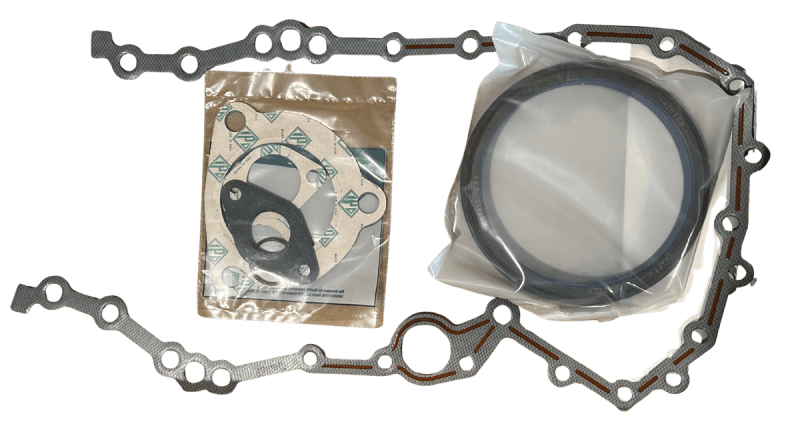
Application: Used to seal the rear crankshaft and flywheel housing area to prevent oil leaks and maintain engine integrity.
Components: The kit typically contains a complete set of gaskets and O-rings, including the crankshaft seal group and flywheel housing gaskets.
Key Components in Kit:
1x Seal Group - Crankshaft (1425868)
1x Flywheel Housing Gasket (1555619)
1x Flywheel Housing Gasket (2348937)
1x O-Ring Seal (2303728)
Various ancillary gaskets (Fuel Filter, Starter, Cover)
Fits Serial Number Prefix 5EK, 6TS, 5DS, 1LW, 2WS, 1MM
Key Signs Your Rear Main Seal Needs Replacement:
Oil Leaks at the Bell Housing: The most definitive sign is engine oil dripping from the bell housing (the area where the engine and transmission connect).
Puddles Under the Vehicle: A noticeable, brown-black oil puddle appears under the center of the car, particularly after it has been parked for some time.
Consistently Low Oil Level: If you have to frequently add oil, but there are no obvious leaks on top or sides of the engine, the rear main seal is likely at fault.
Burning Smell: Oil may drip onto the hot exhaust pipe, creating a distinct burning odor while driving.
Oil on Clutch/Flywheel: In manual transmission vehicles, a failing seal can lead to oil contamination of the clutch, resulting in clutch slippage.
Inspection Cover Oil: Removing the inspection cover on the bell housing might reveal oil inside, confirming the leak.
A failing rear main seal (or rear structure gasket) is primarily indicated by a persistent oil leak located between the engine and transmission, often causing a puddle of oil in the center-rear of the vehicle. Other common symptoms include a burning oil smell, consistently low engine oil levels, and oil on the flywheel or clutch.
Why It Needs Immediate Attention: A faulty rear main seal allows the engine to lose significant oil, potentially leading to low oil pressure, severe lubrication failure, and, in worst-case scenarios, a seized engine due to overheating. Due to its location, replacing this gasket is labor-intensive, often requiring the removal of the transmission.